Most multi-location brands pour their marketing budget into the top of the funnel: ads, SEO, referral incentives, local sponsorships. But a much cheaper growth opportunity sits quietly in their CRM: customers who already know, trust, and have paid for their service, and simply stopped coming back. It’s time to start running win-back campaigns.
This isn’t a call to abandon acquisition. It’s a case for treating win-back as its own disciplined program, not an afterthought triggered by a slow month. Here’s a framework for building one.
Why win-back beats new-customer acquisition on cost and speed
The economics aren’t close. Acquiring a new customer typically means paying for awareness (ads, SEO, local marketing), then paying again in conversion friction — the multiple touches it takes before someone unfamiliar with your brand trusts you enough to book. A lapsed customer has already cleared both of those hurdles. They know your pricing, your service quality, and — often — a specific technician or location they liked.
That’s why reactivation campaigns tend to convert faster and at a lower cost per acquisition than net-new channels. You’re not building trust from zero; you’re reminding someone of a relationship that already existed and giving them a reason to resume it. The message can be shorter, the offer can be smaller, and the sales cycle is often a single touch instead of a multi-week nurture.
The other advantage is speed to revenue. A new-customer funnel has to move a stranger through awareness, consideration, and decision. A lapsed customer can go from “haven’t thought about you in months” to “booked” in one well-timed message, because the decision-making work is already done — they just need a nudge and a reason to act now.
None of this means win-back is free. It requires the same rigor as any acquisition channel: segmentation, sequencing, and measurement. Treated casually — a single blast discount to everyone who hasn’t visited in a while — it underperforms and trains your list to wait for coupons. Treated as a program, it’s often the highest-ROI channel a multi-location brand has.
Step 1: Define “lapsed” before you build a win-back campaign
“Lapsed” isn’t a universal number — it’s a function of your category’s natural visit cycle. A customer who hasn’t returned in 60 days might be perfectly normal in one vertical and a clear warning sign in another.
Start by mapping your own expected interval:
- Recurring, contract-based services (pest control, lawn care): these usually run on a set treatment cadence — often 30, 60, or 90 days depending on the service plan. “Lapsed” here should be defined relative to that customer’s expected next-service date, not a flat calendar threshold. A customer 15 days past their expected treatment is a very different signal than one 15 days past a visit with no set cadence.
- Auto and tire services: visit intervals vary by service type. Oil changes cluster around 3–6 months; tire and larger repair work can be annual or longer. A single “90 days = lapsed” rule will misclassify a large share of your customer base — someone overdue for an oil change and someone on a normal 12-month tire cycle need different thresholds entirely.
- Other recurring-service models (home services, memberships, subscription-style offerings): base the threshold on the service’s actual frequency, plus a buffer for normal scheduling variance.
The practical move is to calculate an expected next-visit window per customer (or per service type) using their own history, rather than applying one flat cutoff to the entire database. A brand that uses a single “6 months and you’re lapsed” rule across every service line will either flag people too early (annoying them) or too late (missing the window when a win-back message actually works).
Step 2: Segment before you message anyone
 Once you know who’s lapsed, resist the urge to message all of them the same way. Two variables matter most:
Value. Not every lapsed customer is worth the same investment. Segment by historical spend, visit frequency, and service mix. A high-value customer who lapsed after years of regular visits deserves a more personal, higher-touch outreach — potentially even a phone call or a location manager’s involvement — than a one-time, low-spend customer. This also tells you where to set discount depth: a customer with high lifetime value can often be won back without a discount at all; a low-value, one-time customer may need a stronger incentive to make the reactivation worth the cost.
Reason for lapsing. Not all churn is equal, and treating it as one bucket wastes messaging opportunities:
- Price-sensitive lapses — customers who mentioned cost, or whose visit frequency dropped right after a price increase — respond to value-reinforcement or loyalty-program messaging, not necessarily a discount.
- Service-related lapses — a bad experience, a complaint, a missed appointment — need an acknowledgment or a fresh-start message before any offer will land. Sending a generic discount here can reopen a wound instead of repairing it.
- Life-circumstance lapses — moved, sold the vehicle, canceled a service that’s no longer relevant — should be suppressed from win-back entirely rather than messaged repeatedly.
- Passive lapses — no clear negative signal, just drift — are usually the easiest and cheapest to win back with a simple reminder.
If you have any qualitative data — service notes, complaint logs, cancellation reasons — this is where it earns its keep. Segmentation without a “why” is really just a mailing list sorted by date.
Step 3: The win-back campaign journey: trigger, sequence, offer, escalation
A win-back program is a journey, not a single email. A useful default structure:
Trigger. The moment a customer crosses into “lapsed” status for their segment — ideally calculated against their expected next-visit window (see Step 1), not a flat date.
30 days past expected visit — the reminder. Low-pressure, no discount. Frame it as a helpful nudge: a service reminder, a seasonal tie-in, or a “haven’t seen you in a while” message. This stage exists to catch passive lapses cheaply before they need an incentive at all.
60 days — the value reinforcement. For customers who didn’t respond to the reminder, introduce a modest incentive or a reason tied to value rather than price alone — a loyalty point boost, a bundled service, or a reminder of what’s changed (new hours, new technician, new capability) since their last visit. This is also the stage to differentiate by lapse reason: price-sensitive segments get a different message than service-complaint segments.
90+ days — the escalation. For your highest-value at-risk customers, this is where higher-touch outreach earns its cost: a phone call, a personalized note from a location manager, or a stronger, time-bound offer. For lower-value segments, this may simply be a final, slightly stronger offer before moving them to a long-term dormant list with reduced messaging frequency.
Suppression exit. Anyone who reactivates should immediately exit the win-back sequence and re-enter normal lifecycle messaging — sending a “we miss you” email to someone who booked yesterday is one of the fastest ways to erode trust in your marketing.
Step 4: What to measure
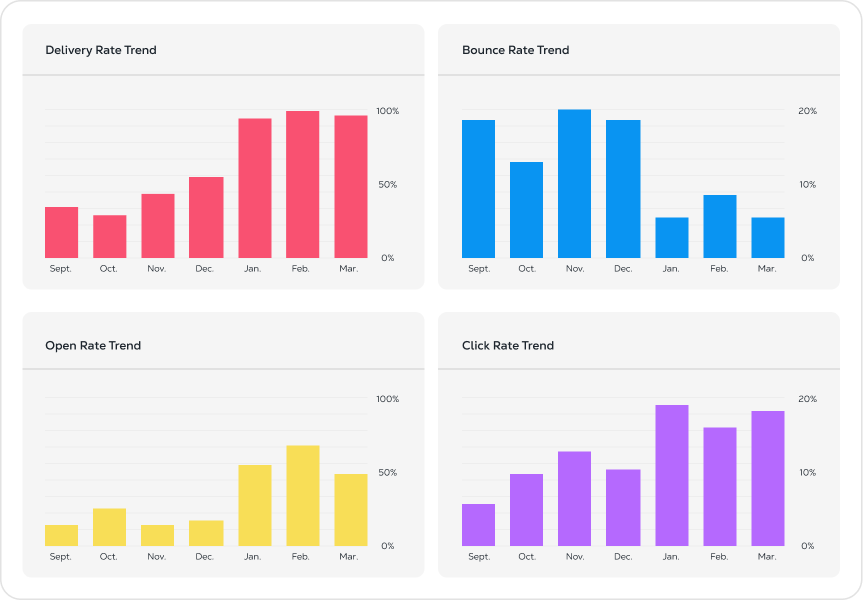 A win-back program needs its own scorecard, separate from general email or campaign metrics:
- Recapture rate — the percentage of a lapsed segment that rebooks within a defined window after entering the journey. Track this by segment (value tier and lapse reason), not just in aggregate — an averaged number hides which segments are actually working.
- Revenue recovered — total revenue from reactivated customers, ideally tracked against what those customers would have been worth if you’d acquired them fresh, to make the cost comparison concrete.
- Cost per reactivation — total program cost (messaging, incentives, any manual outreach) divided by the number of customers reactivated. This is your direct comparison point against cost-per-acquisition for new customers, and it’s usually the number that makes the case for continued investment.
- Time to reactivation — how long it takes a customer to rebook after entering the journey, by stage. If most of your recaptures are happening at the 90-day escalation stage, that tells you the earlier touches may need work, or that the discount is doing the job the reminder should be doing.
- Re-lapse rate — of customers who reactivate, how many lapse again within a similar window. A high re-lapse rate usually signals a service or experience issue, not a messaging one — no win-back sequence fixes a problem that caused the original churn.
Common mistakes
Blasting the whole list with one generic discount. This is the default move for a reason — it’s easy to execute — but it trains your most loyal, highest-value customers to wait for a coupon instead of rewarding them for coming back, while doing little to address customers who left for a real reason (price, service, life change) that a blanket 15%-off doesn’t touch.
No segmentation. Treating a customer who lapsed last week the same as one who lapsed 18 months ago — or treating a high-value regular the same as an infrequent, low-spend visitor — wastes both the message and the incentive budget on the wrong audience.
No suppression logic. Continuing to send win-back messaging to customers who’ve moved, sold the relevant asset, or explicitly opted out isn’t just wasteful, it damages brand trust and deliverability. Suppression rules should be built into the program from day one, not bolted on after complaints.
Ignoring reason for lapse. A single journey applied to everyone — regardless of whether they left over price, a bad experience, or simple drift — will underperform a segmented approach every time, because the message that works for a distracted-but-happy customer can actively backfire on someone who left upset.
Treating win-back as a one-time campaign instead of an always-on program. Customers lapse continuously, so the journey should be evergreen and trigger-based, not something you run once a quarter as a special promotion.
Where to start: Pull your customer list and calculate, by service line, how many customers have crossed your lapsed threshold — and how much revenue they represent if reactivated at even a modest recapture rate. That number is usually the fastest way to make the case for building this program properly.


 9 MIN READ