Not all customer journeys are created equal. While it’s tempting to think that stringing together a few automated emails and calling it a day is enough—seasoned marketers know there’s an art and a science to building journeys that actually mean something to both your business and your customers.
This guide lays out core best practices for designing effective customer journeys. No jargon, no magic tricks—just practical steps that turn intent into impact, whether you’re welcoming new clients, rekindling interest from the long-lost, or simply trying to keep loyal fans coming back for more.
Step 1: Define a Clear Goal
Before touching any automation platform, clarify what you want the journey to achieve. Is it onboarding new users? Driving reviews? Increasing repeat purchases? Each goal should be specific, measurable, and tied to real business outcomes—not just “send more messages.”
Examples of strong journey goals:
- Guide new customers in their first 30 days
- Win back users who haven’t engaged for 60+ days
- Encourage loyal customers with targeted rewards
Step 2: Set Entry Criteria—Who Belongs on This Journey?
A journey is only as good as the people who get to walk it. Define clear, data-driven entry rules. These could be based on customer segments (“first-time buyers”) or triggered by specific behaviors (“hasn’t responded to a campaign in three months”).
The better your entry criteria, the more relevant your journey feels (and the less likely you’ll annoy people who just aren’t interested).
Step 3: Map Out the Steps and Flow
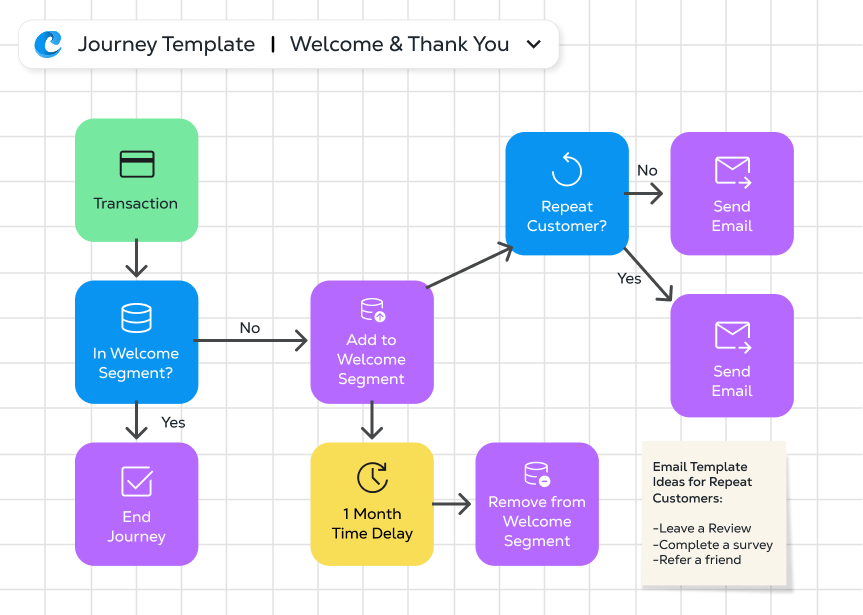
Here’s where you get to play architect. Sketch out each stage of the journey—think messages, offers, surveys, or even branching paths based on actions taken (or…not taken). Visual mapping helps spot gaps or awkward timing, and lets you experiment with personalized logic.
Common Journey Steps Include:
- Delays (waiting periods between touches)
- Conditional branches (“if clicked, send offer; if no response, nudge again”)
- Multichannel touches (email, SMS, direct mail, whatever fits your audience)
- Exit rules (remove from journey after goal completion)
Step 4: Personalization—Make It Human
Personalization turns generic flows into meaningful conversations. Use data wisely—not just to say “Hi [FirstName],” but to segment by interests, purchase history, or engagement level. Dynamic content can ensure the right people see the right message at the right time.
Tactics to personalize:
- Merge tags for names, milestones, or loyalty points
- Offer variations based on customer status (e.g., VIPs vs. new users)
- Smart send times based on individual or group behaviors
Step 5: Test and Quality Assurance
Test, preview, and test again! Run real contacts through the journey in a test setting to catch broken links, missing personalization, or tangled branches. It’s way easier to spot issues before customers do, and a little catch now can prevent a lot of “Oops, sorry!” emails later.
Checklist for QA:
- All dynamic tags pull correct data
- Branches and delays work as expected
- Actions trigger the intended responses
Step 6: Launch and Monitor
The journey doesn’t end at “launch.” Use analytics and feedback to see where people drop off or rush ahead. Track key metrics—open rates, clicks, conversions, but also customer satisfaction and revenue impact. Refine, reposition, and relaunch as needed. Iteration is your best co-pilot.
Why Cinch Is a Smart Choice for Building Journeys
All of the above sounds great on paper, but even the best plan falls flat with clunky tools. Cinch makes implementing these best practices refreshingly straightforward—and a bit more fun.
What sets Cinch apart?
- Native CDP integration: Data lives in one place, making it easy to segment, personalize, and act on real customer insights—no hunting through plugins or exporting spreadsheets.
- Omnichannel execution: Email, SMS, direct mail, voice, loyalty points, and even survey responses are all at your fingertips in a single workflow.
- Drag-and-drop simplicity: You map journeys visually, with intuitive branching—so you can focus on strategy, not setup headaches.
- Operational automation meets marketing: Beyond campaigns, automate reviews, scheduling, and loyalty programs right from the journey builder.
- Analytics you’ll actually use: Real-time step-level tracking to spot what’s working, where people drop off, and how each flow drives results.
When it comes to building powerful, personalized journeys that actually move the needle, Cinch is designed to help you work smarter, not harder—all while keeping both technology and process approachable, flexible, and, yes, a little bit fun.

 4 MIN READ